

Let’s start with something that rarely gets said out loud in the sustainability conversation. Most Australian businesses are genuinely good businesses, run by capable people, doing real and valuable things. They employ locals, they pay their suppliers, and they build products and deliver services that customers actually want. They generate value the old-fashioned way, by being good at what they do.
For most of these businesses, climate management has never been part of that value-generation story. It hasn’t needed to be. Nobody built the company around a carbon strategy, the customers aren’t asking for a Scope 3 breakdown, and the margin doesn’t improve one cent because you measured your emissions. So when mandatory climate reporting lands on the desk, the reaction isn’t excitement. It isn’t even mild curiosity.
It’s irritation. And if we’re being honest, for a lot of business owners and finance leaders it’s closer to anger. Anger at another compliance burden. Anger at being made to account for something that has nothing to do with why the business exists. Anger at the implication, however unspoken, that a perfectly good company is somehow a problem that needs managing.
That’s a completely reasonable way to feel. But feelings, unfortunately, don’t get the report filed.
So the real question isn’t how do I learn to love climate reporting. You don’t have to. The question is far more practical. How do you navigate this thing without losing your mind? How do you tick the box, produce a report with a reasonable and defensible narrative, avoid coming across as an earth-killer who doesn’t care, and at the same time avoid accidentally committing yourself to some grand, magical, world-saving climate plan you have no intention of delivering?
The good news is that there’s a well-worn path through the middle. It isn’t hard, and it doesn’t require you to become a believer. It just requires you to be organised. Here’s how it works.
Step one: decide who owns it
Nothing kills a compliance process faster than orphaned responsibility. If climate reporting belongs to “everyone,” it belongs to no one, and it will sit untouched until three weeks before the deadline, at which point it becomes a genuine crisis.
So the very first decision, before you engage anyone, before you spend a dollar, before you think about emissions or governance or any of it, is to name an owner. One person. Ideally your CFO, or another senior individual who understands the business and the industry deeply. This matters, because climate reporting is far more about how your business works than it is about climate science. The person who can look at a list of risks and say “that one’s real for us, that one’s irrelevant, that one’s actually an opportunity” is the person who knows the business cold. That’s almost always your finance chief or an equivalent key operator.
Now for the part nobody enjoys. This person is going to resist. They will point out, correctly, that they already have a full plate. They will explain that this isn’t their area. They may kick and scream about it. That’s fine. Let them have their moment.
Then tell them to suck it up and own it anyway.
It sounds blunt because it is. But the alternative, a diffuse and unowned process, is genuinely worse for everyone, the reluctant owner included. Clear ownership is what makes the rest of this easy, and “easy” is the whole objective here. Once someone is unambiguously accountable, the process has a spine. If you want a sense of what good looks like in practice, our guide to building a climate governance framework for Group 2 and 3 entities walks through how that accountability gets documented.

Step two: get help
Here’s what most owners don’t realise until they’re partway in: you can outsource the overwhelming majority of this work. You are not expected to build an in-house climate team. You are not expected to become an expert. What you need is a good partner, and if you pick the right one, it won’t cost anywhere near what you fear. Our breakdown of what mandatory climate reporting actually costs is a useful reality check before you start budgeting for worst-case numbers.
The right partner does the heavy lifting and leaves you with only the small handful of decisions that genuinely require someone inside the business. Your job becomes judgement and sign-off, not research and production. If you’re weighing your options, compare consulting versus DIY reporting and run through the eight questions worth asking any AASB S2 consultant.
So what does the right partner actually do? A good one follows a recognisable pattern.
First, they understand your current state of play
Which, let’s be honest, is usually nowhere. No emissions measured, no climate governance, no climate risk process. That’s not a failing. It’s the completely normal starting point for the vast majority of businesses caught by these rules. A good partner isn’t fazed by “we’ve done nothing.” They expect it. It’s the baseline they work from every day. A quick pass through an AASB S2 readiness checklist will tell you exactly how far from the line you are.
Second, they map your existing governance
This is where a lot of the anxiety quietly evaporates. A good partner looks at how your organisation is already governed and managed, and works out where climate governance can slot into what you already have. The key phrase is no new structures and no new hires. You do not need to build a climate department. You do not need to recruit a Chief Sustainability Officer. You have management meetings, you have decision-makers, and you have reporting lines. Climate governance gets fitted into that existing furniture rather than bolted on as an expensive extension.
Third, they look at your risk management
Next, the partner examines how you currently manage risk and asks a simple question: could this process work for climate too? Usually the honest answer is no. Most existing risk processes weren’t built with climate in mind and don’t quite fit. But that’s not a problem either, because a simple climate risk framework can be established quickly. We’re talking a matter of minutes to set up the basic structure, not months of consulting. It’s far less intimidating than it sounds.
Then, they build the path forward
Once the partner understands your governance and your risk position, they can lay out a clear path. In practice, that path almost always includes the following, running in parallel so the whole thing moves quickly.
A charter for a “sustainability committee” made of people you already have. The partner drafts a new charter or terms of reference for a sustainability committee, but here’s the trick: it’s staffed by existing managers meeting within an existing management meeting structure. You’re not creating a new committee that adds meetings to everyone’s calendar. You’re formalising oversight within a forum that already meets. On paper it’s proper governance; in reality it’s your regular leadership discussion with a standing agenda item.
A pre-scanned list of climate risks and opportunities for you to score. Rather than making you invent risks from a blank page, the partner runs a market scan of similar businesses in your industry and hands you a ready-made list of the climate-related risks and opportunities that typically apply. Your only job is to score them, to apply your deep knowledge of the business and say how relevant and material each one really is. This is one of the few genuinely you tasks in the whole exercise, and it takes a fraction of the time of building the list yourself.
Scenario and detailed risk scoring, done for you. You send the scored list back, and the partner runs the detailed work, generating the scenario analysis and applying detailed risk scoring against the climate risk framework you’ve now established. You provide the business judgement; they turn it into the structured, methodical output that a report requires.
A governance and risk narrative you’re comfortable with. The partner then drafts the governance and risk narrative for your mandatory sustainability report, the words that explain how all these pieces link together. This matters more than almost anything else, because the narrative will be publicly available. You get to read it, shape it, and sign off knowing exactly what is being said about your business before anyone else sees it. No surprises, and no accidental commitments. It’s a reasonable, defensible account of how you’re managing climate as a business issue, nothing more and nothing less.
Emissions measurement, running quietly alongside. While all the governance and narrative work happens, the emissions calculation process kicks off. It starts with defining your emissions boundary, essentially deciding what needs to be measured, and then working out what data to collect to calculate those emissions. Then the data actually gets collected, which is typically handled by a financial controller or analyst inside your business pulling together information that, in most cases, you already have sitting in your systems. That data is then reviewed, assessed for completeness, and calculated by the service provider. You supply the raw material; they do the maths and the assurance-grade rigour.
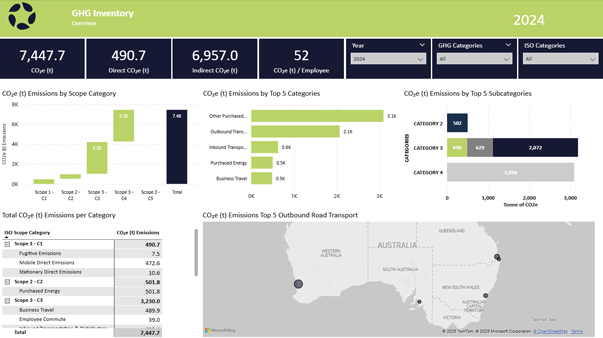
Assembly into a finished draft. Everything then gets assembled into a final sustainability report draft, complete with a full audit trail, the agreed narrative, and a structure designed for a smooth, drama-free approval process.
What this actually costs you in time
Here’s the number that surprises people. Add up the internal effort across this entire process, the part you and your people actually have to do, and it’s remarkably small. A few hours on the disclosures, mostly scoring risks and reviewing narrative. Maybe a few hours collecting data. That’s it.
Everything else is done by your service provider.
The end result is a well-presented sustainability report with the correct, measured narrative, one that accurately reflects your new governance and risk processes, both of which turned out to be genuinely easy to establish. ASIC is satisfied because you’ve met the requirements properly. Your auditors are happy because the report arrives with a clean audit trail and a coherent story, which makes their job efficient. And your owners are happy because the whole thing got done without consuming the business or blowing the budget. Box ticked, reputation intact, and no magical world-saving pledges signed in your name.
The one thing you must not do
There is a single mistake that turns this easy process into a painful one, and that’s leaving it until year-end.
You cannot report on processes that didn’t exist. That isn’t a technicality; it’s the whole logic of the thing. If your governance committee, your risk framework, and your data collection only came into being in the final fortnight, there’s nothing genuine to describe, and the report becomes a scramble to retrofit a story onto nothing. It shows, and it doesn’t hold up. It matters even more once assurance requirements step up towards 2030.
Start early and the processes have time to actually operate, which means you have something real and defensible to report on. There’s also a purely commercial reason to move early. Leave it too late and you’ll find fewer service providers with capacity, less room to negotiate on price, and a narrower choice of who you work with. Early movers get better service for less. Late movers pay a premium for whoever’s left.
So, get on with it
Here’s the bottom line. It is not hard to make mandatory climate reporting work, even if you don’t care about climate at all. The path is well established, the internal effort is minimal, and the cost is manageable when you pick the right partner and start in good time.
Plenty of businesses that went in reluctantly discovered something they didn’t expect. Sometimes the narrative genuinely helps: a credible, well-articulated position on climate risk turns out to open doors with customers, tender panels, and lenders who increasingly ask for it. Sometimes it’s the staff, who quietly appreciate knowing their employer is taking these issues seriously, even in a measured and pragmatic way. You don’t have to go looking for those upsides, but don’t be shocked if they turn up.
You don’t have to love this. You don’t have to change who you are or what your business stands for. You just have to be organised, name an owner, get the right help, and start early.
If that sounds like your business, talk to the CarbonHalo team about getting the whole thing handled with minimal internal effort.